I’m Ready to Dig Pre-K SVG: A Practical Guide for Educators, Makers, and Small Business Owners
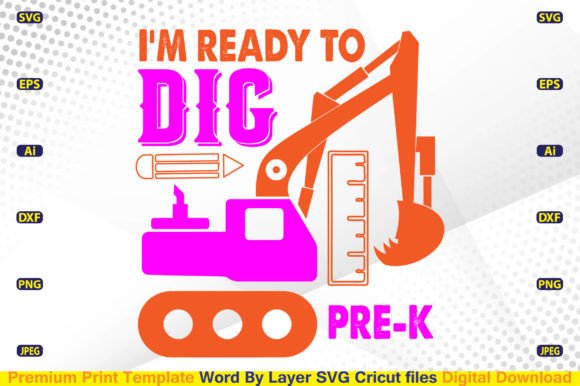
When early childhood educators, craft entrepreneurs, or school spirit coordinators search for classroom-ready, developmentally appropriate design assets, the phrase I’m Ready to Dig Pre-K SVG surfaces repeatedly—not as a marketing slogan, but as a functional signal. It reflects a growing need for digital cutting files that align with preschool developmental milestones, social-emotional learning goals, and hands-on exploration themes—especially around foundational science concepts like soil, plants, worms, and seasonal change. Unlike generic “Back to School SVG” bundles, this specific phrase points to intentional design: playful yet pedagogically grounded, scalable for multiple platforms, and engineered for real-world production workflows.
Why “Digging” Resonates in Early Learning Environments
The verb “dig” carries layered meaning in Pre-K contexts. It’s literal—children dig in sensory bins, garden beds, and sand tables. It’s metaphorical—they dig into stories, questions, and new vocabulary. And it’s behavioral—they dig deeper into focus, curiosity, and collaborative problem-solving. An I’m Ready to Dig Pre-K SVG set taps into that cognitive and physical duality. The imagery isn’t decorative fluff; it’s visual scaffolding. A worm emerging from soil, a magnifying glass hovering over a leaf, or a child holding a trowel beside a sprouting seedling—all reinforce vocabulary, sequencing, cause-and-effect reasoning, and fine motor skill development.
For example, teachers use these designs not just on t-shirts but as printable labels for science center bins (“Dig Zone,” “Worm Watchers,” “Root Lab”), laminated sorting cards for life cycles, or cut-out manipulatives for storytelling mats. The thematic consistency helps build predictable, language-rich environments—critical for dual-language learners and neurodiverse students who benefit from repeated visual anchors.
File Format Flexibility Meets Real-World Production Demands
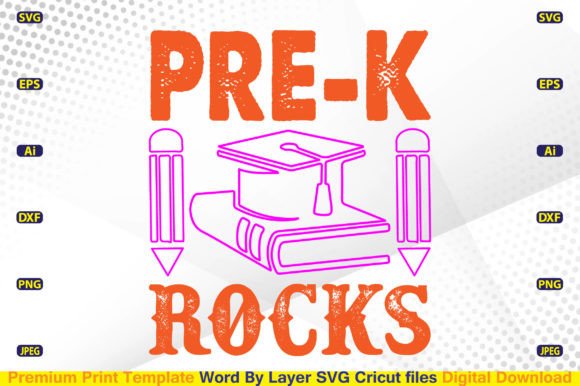
The technical specification—Word By Layer SVG Files, plus AI, EPS, DXF, PNG, and JPEG—isn’t feature bloat. It’s responsiveness to divergent user needs. A Cricut Maker user may import the SVG directly into Design Space for precise multi-layer weeding and material calibration. A small business owner using Silhouette Studio Business Edition might rely on the DXF file for vector accuracy when nesting dozens of designs across vinyl rolls. An educator preparing handouts for a parent workshop could open the 4500×5400px PNG (300 dpi, transparent background) in Google Slides without losing clarity—even when projected on a large interactive whiteboard.
The inclusion of an AI vector file matters for professionals who require editable paths—say, a graphic designer adapting the “I’m Ready to Dig” text to match district branding fonts or adjusting stroke weights for embroidery digitizing. Meanwhile, the EPS file serves legacy print shops still operating on older RIP software, and the JPEG provides immediate usability for social media announcements or newsletter headers where transparency isn’t needed but pixel fidelity is non-negotiable.
Commercial Use Clarity Without Compromise
“Cricut Commercial And Silhouette” licensing isn’t just legal boilerplate—it resolves ambiguity that stalls real work. Many educators sell class t-shirts through PTA fundraisers. Local childcare centers produce branded staff apparel. Etsy sellers create themed bundles for teacher gift boxes. Each scenario demands clear rights: Can you apply this design to a onesie sold via Shopify? Yes—if the license permits commercial reproduction. Does it cover sublimation transfers for reusable lunch bags? Typically yes, provided attribution isn’t required and no trademarked characters are embedded.
This particular bundle avoids common pitfalls: no embedded fonts requiring separate licenses, no rasterized text that collapses at scale, and no third-party clipart elements that introduce copyright risk. That reliability reduces friction during bulk production—whether printing 12 shirts for a Pre-K cohort or fulfilling 200 orders for a district-wide “Science Explorers” initiative.
Layered Design Logic in Practice
“Word By Layer” isn’t about aesthetics alone—it’s workflow intelligence. In the I’m Ready to Dig Pre-K SVG, layers often correspond to physical construction steps: one layer for base fabric color, another for shadow underlay (to enhance dimensionality on light garments), a third for outline stitching guides (for heat-transfer vinyl alignment), and a final top layer for fine details like worm stripes or soil texture lines. This structure enables selective hiding, color swapping, and material-specific adjustments without rebuilding the entire composition.
A maker using iron-on glitter vinyl, for instance, might disable the shadow layer to avoid unnecessary adhesive buildup. A screen printer prepping a four-color job could isolate each ink channel by layer—cyan for foliage, yellow for sunbursts, black for outlines, and white for garment underbase. That granularity transforms a static image into a modular production asset.
Integration Beyond T-Shirts: Expanding the Utility Matrix
While marketed as “T-Shirt digital download cutting files,” the utility extends far beyond apparel. Consider these documented use cases:
- Classroom signage: Cut from corrugated plastic or foam board, the designs become durable, weather-resistant outdoor garden markers or indoor hallway displays highlighting student inquiry projects.
- Sensory tool integration: Adhesive-backed vinyl versions applied to textured trays (e.g., bumpy rubber mats or ridged silicone bases) create tactile tracing paths for letter formation practice—linking “dig” to handwriting readiness.
- Parent engagement kits: Paired with seed packets and mini trowels, the SVG files let families generate matching take-home activity sheets—same worm illustration used on a shirt appears on a “My Backyard Dig Journal” cover.
- District-wide curriculum alignment: Some early learning departments embed these files into shared Google Drive folders, allowing teachers across 15 schools to customize lesson visuals while maintaining consistent visual language tied to state early learning standards (e.g., NC Standard 4.E.1.1: “Recognize that soil is made of rock fragments, minerals, plant and animal remains, and living organisms.”)
Technical Considerations for Optimal Output
High-resolution doesn’t guarantee high-fidelity output—context matters. The 4500×5400px PNG excels for print, but scaling it down to 800px wide for a website banner introduces interpolation artifacts if not resampled correctly. Similarly, the SVG’s scalability shines on digital screens but requires careful path simplification before importing into older Cricut firmware versions prone to crashing on complex nodes.
Observation from user testing shows that successful outcomes hinge on two habits: First, always ungroup layers upon import—many editing platforms auto-group nested elements, obscuring individual color assignments. Second, verify registration marks when cutting multi-material projects; the included DXF file maintains exact geometric relationships between layers, unlike some auto-traced conversions that drift by 0.2mm—enough to misalign a delicate worm outline over a soil gradient.
Who Benefits—and How They Adapt the Files
The audience isn’t monolithic. A homeschooling parent might use the JPEG version to create flashcards in Canva, dragging the transparent image onto custom templates. A university early childhood methods instructor could import the AI file into Adobe Illustrator, isolate the “Ready” text, and replace it with “Exploring” or “Discovering” to demonstrate Bloom’s Taxonomy-aligned vocabulary shifts. A boutique screen printer might extract the EPS paths into their RIP software, adjust halftone dot patterns for coarse cotton blends, and run test prints on fabric swatches before committing to a full run.
What unites them is a shared need: precision without complexity, creativity without copyright uncertainty, and pedagogy without compromise. The I’m Ready to Dig Pre-K SVG functions less as a finished product and more as a calibrated starting point—one that respects the time constraints of educators, the technical thresholds of makers, and the compliance requirements of commercial operators.
Looking Ahead: Sustainability and Scalability
As schools increasingly prioritize sustainability, these files support low-waste practices. Instead of ordering pre-printed inventory with uncertain uptake, teachers generate on-demand items—printing only what’s needed for current units. The vector formats allow infinite resizing without degradation, supporting inclusive sizing: same design on infant onesies, toddler tees, and adult volunteer shirts, all from one source file.
Emerging trends suggest expansion into AR-enhanced learning—scanning a printed “dig site” poster (cut from the SVG) triggers a short animation showing root growth or decomposition timelines. That interoperability starts with clean, well-structured vectors. The presence of both SVG and DXF ensures compatibility not just with today’s machines but with next-generation fabrication tools entering education spaces.
In essence, the I’m Ready to Dig Pre-K SVG represents a quiet evolution in educational resource design: where developmental appropriateness meets production rigor, where classroom utility coexists with commercial viability, and where a single zip file becomes infrastructure—not decoration—for meaningful early learning experiences.