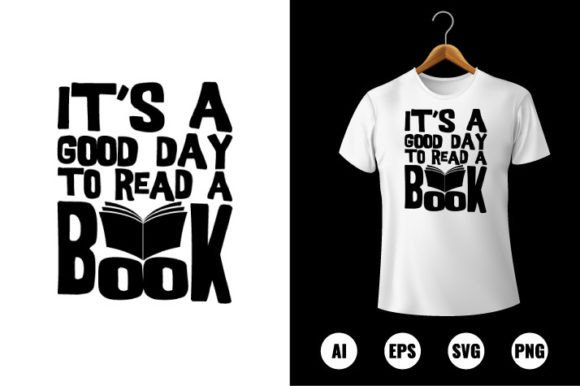
It’s a Good Day to Read a Book T-shirt
At its core, It’s a Good Day to Read a Book T-shirt is more than just text on fabric—it’s a versatile, print-ready digital design built for real-world use. This isn’t a low-res JPEG you’ll struggle to scale or recolor. It’s a professionally crafted vector bundle with AI, EPS, PNG, and SVG files—each optimized for different workflows and output needs.
Why this matters—depending on who you are
If you’re an educator preparing for back-to-school season, this design speaks directly to classroom culture: quiet confidence, curiosity, and the simple joy of reading. You might print it on tote bags for library volunteers, vinyl-cut it onto classroom banners, or embed it into a student-made “Reading Challenge” poster. The 100% color-changeable vectors mean you can match your school’s palette without hiring a designer—or even opening Illustrator.
For small business owners running a local bookstore, indie press, or literacy nonprofit, the value shifts toward branding consistency and speed. Need matching staff tees, window decals, and social media graphics—all by Friday? These files let you adapt one design across six formats in under an hour. No pixelation when scaling to a 4'×8' banner. No extra fees for color adjustments. Just reliable, editable assets that behave the same whether you’re printing on cotton, engraving wood, or cutting heat-transfer vinyl.
Hobbyists and scrapbookers appreciate something else entirely: flexibility without friction. The SVG and PNG versions work seamlessly in Cricut Design Space or Silhouette Studio. You can isolate individual letters, layer the phrase over vintage book illustrations, or shrink it down to fit a 2" sticker sheet. Because every shape is vector-based and fully resizable, there’s no guesswork about resolution—just clean, crisp results at any size.
What “easy to edit” really means in practice
“Easy to edit” isn’t marketing speak here—it reflects intentional file architecture. Each word, punctuation mark, and decorative element lives on its own layer or path. In Adobe Illustrator CC (the version used to build these files), you can:
- Select just the word “Book” and swap its fill color while leaving the rest unchanged
- Ungroup the entire phrase and reposition “Read a” to stack vertically beneath “It’s a Good Day to”
- Copy the open-book icon (included in many variants) and paste it as a standalone graphic for a bookmark or canvas print
- Export only the SVG version for web use, or only the 300 DPI PNG for high-end photo paper prints
This level of control matters differently depending on your tools and goals. A freelance graphic designer might dive straight into the AI file to integrate the design into a larger brand system. A teacher using Canva might prefer the transparent-background PNG—drag, drop, and done. A laser engraver may rely on the clean vector paths in the EPS file to ensure precise cuts on acrylic or leather.
Quality that holds up—not just on screen, but in hand
The 300 DPI resolution and vector foundation ensure fidelity across physical outputs. That means:
- No blurriness when printed on a soft tri-blend tee at 12" wide
- No jagged edges when etched onto a wooden notebook cover
- No color banding when reproduced on matte sticker stock or glossy canvas
For creators selling printable reading journals or classroom kits, this reliability translates directly to customer trust. When your buyer downloads the file and prints it at home—on an Epson ET-2800 or a Canon PIXMA—and it looks exactly like the preview? That’s repeat business. That’s word-of-mouth referrals. That’s why “print ready” isn’t a checkbox—it’s baked into every export setting, bleed margin, and color profile.
Where creativity meets practicality
Beginners often assume vector editing requires years of training. Not with this set. Because all shapes are fully separated and labeled intuitively (e.g., “text_line_1”, “comma”, “book_icon”), even someone who’s only used PowerPoint can learn to change colors or delete an element in under five minutes. There’s no hidden clipping mask or embedded raster image to trip you up.
Experienced users, meanwhile, will notice thoughtful details: consistent stroke weights, aligned anchor points, and CMYK-safe color defaults. The AI file opens cleanly in newer versions of Illustrator without font substitution warnings—because all text has been converted to outlines. And if you do want to add custom typography later? The original font name is documented in the README (included in the download), so you can license it separately if needed.
Thinking beyond the t-shirt
While the name highlights apparel, this design thrives in contexts far beyond clothing. Consider:
- Librarians: Printing the phrase on laminated shelf-talkers next to new YA releases
- Bloggers & podcasters: Using the SVG as a watermark on episode thumbnails or Pinterest pins
- Hand-lettering artists: Tracing the vector outlines as a base for inked reinterpretations
- Home organizers: Vinyl-cutting the phrase onto clear acrylic drawer labels for a “reading nook” cabinet
- Publishers: Adapting the layout for a limited-edition chapbook cover, keeping the same typographic rhythm and warmth
None of those uses require redesigning from scratch. They rely on the same foundational files—just repurposed with intention.
Does this fit your next project?
Ask yourself:
- Do you need a design that works *now*—not after hiring help or learning new software?
- Will you use it across multiple products (stickers + shirts + digital graphics)?
- Is consistent color, sizing, and clarity non-negotiable—for your audience or your own standards?
- Do you value having full ownership and control, rather than licensing restrictive clip art?
If you nodded yes to two or more, It’s a Good Day to Read a Book T-shirt isn’t just a design—it’s infrastructure. It saves time not by cutting corners, but by removing avoidable friction: between idea and execution, between skill level and outcome, between what you imagine and what you can reliably make.
And whether you’re pressing it onto organic cotton, etching it into bamboo, or pasting it onto a handmade journal cover—you’re not just applying a phrase. You’re inviting attention, honoring quiet focus, and making space for stories to begin.