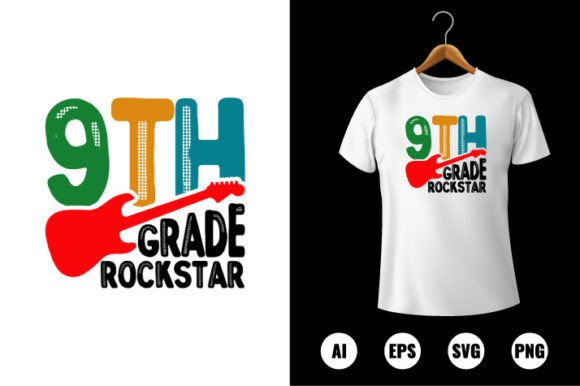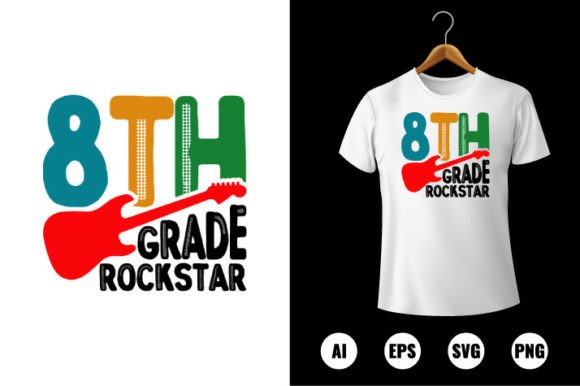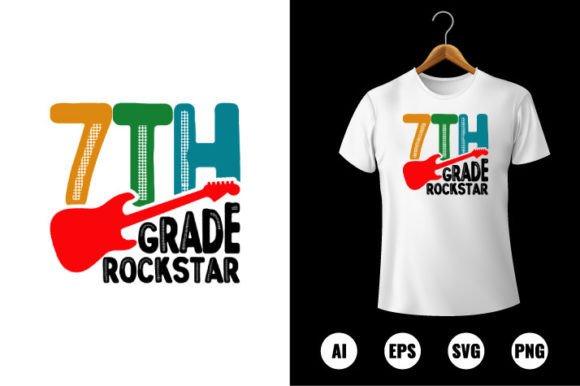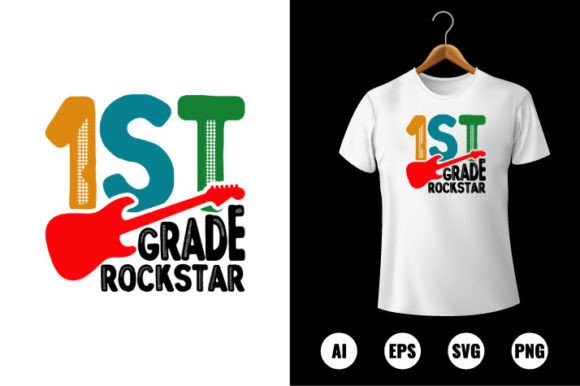
1st Grade Rockstar T-shirt Design
The 1st Grade Rockstar T-shirt Design is more than a playful back-to-school graphic—it’s a versatile, production-ready digital asset built for intentionality. Designed with educators, small business owners, print-on-demand entrepreneurs, and creative professionals in mind, this file set delivers immediate utility across multiple physical and digital applications: apparel printing, vinyl cutting, sticker production, scrapbooking, classroom décor, and custom canvas art. Its strategic value lies not in novelty alone, but in how thoughtfully it integrates into your workflow, branding, or learning environment—when used with clear purpose.
Why This Design Fits Real-World Goals
For teachers preparing classroom culture, the 1st Grade Rockstar T-shirt Design supports social-emotional learning by reinforcing identity, confidence, and belonging. When students wear or help create items featuring this motif, they’re engaging with a visual language of achievement—not just academic, but personal growth. For small businesses selling school-themed merchandise, it offers a differentiated yet universally resonant concept: “rockstar” signals energy and capability without relying on overused tropes like apples or pencils. That distinction matters when standing out in crowded marketplaces like Etsy, Amazon Merch, or local school spirit fairs.
From an operational standpoint, its technical specifications reduce friction: AI, EPS, SVG, and PNG files at 300 DPI ensure crisp output whether printed on cotton tees or laser-cut for acrylic keychains. The 100% vector-based construction means no pixelation at any scale—critical when resizing for tote bags, bulletin board letters, or large-format wall decals. And because every element is color-changeable and fully editable in Adobe Illustrator CC, you’re not locked into one palette. You can align it with school colors, brand guidelines, or seasonal campaigns—without redesigning from scratch.
Strategic Use Cases Beyond the Obvious
Most buyers reach for the 1st Grade Rockstar T-shirt Design for apparel—but its highest leverage often appears elsewhere:
- Classroom onboarding kits: Print the design on stickers, bookmarks, and reward cards to build consistency across materials—reinforcing expectations while minimizing prep time.
- Small business bundling: Pair the SVG file with editable lesson plan templates or printable behavior charts. Offer them as a “Back-to-School Launch Kit” for educators—increasing average order value and perceived expertise.
- Local partnerships: Collaborate with a print shop or craft fair vendor to co-brand limited-run shirts using this design. You supply the file; they handle fulfillment. It lowers your overhead while expanding reach through trusted local channels.
- Digital course enhancements: Embed the PNG version into online modules for early elementary education courses. Use it as a progress marker (“You’ve leveled up to Rockstar Reader!”), making abstract milestones tangible.
Each application succeeds only when anchored to a specific outcome—not just “making something look nice.” Ask yourself: Does this use support student engagement? Strengthen brand recognition? Reduce repetitive design work? Accelerate time-to-market? If the answer isn’t clear, pause. A technically excellent file doesn’t compensate for unclear intent.
What to Consider Before You Edit—or Sell
Before opening Illustrator to tweak colors or rearrange text, consider three practical constraints:
- Licensing scope: Confirm whether your intended use falls within standard commercial rights—especially if distributing digitally (e.g., as part of a Canva template pack) or embedding in SaaS platforms. Some licenses restrict resale of unmodified files or require attribution.
- Production compatibility: While SVG and EPS are widely supported, not all DTG (direct-to-garment) printers handle layered transparency the same way. Test a small batch first—particularly if applying gradients or drop shadows to the starburst or microphone elements.
- Audience alignment: “Rockstar” resonates strongly with U.S. and Canadian elementary communities—but may feel culturally dissonant in regions where musical metaphors carry different connotations. If serving international schools or bilingual programs, assess tone alongside translation.
Also note: The claim of “100 color-changeable” elements assumes familiarity with Illustrator’s Recolor Artwork tool or global swatch management. Beginners may need 15–20 minutes of focused practice before confidently adjusting hues across complex layers. Don’t assume ease—build that learning time into your timeline.
Avoiding the “Just Because It’s Ready, I’ll Use It” Trap
Having access to 100 print-ready, resizable vector shapes doesn’t mean every project benefits from all of them. Over-editing—adding unnecessary outlines, stacking drop shadows, or forcing font substitutions—can dilute clarity and increase file size without improving function. Worse, deploying the 1st Grade Rockstar T-shirt Design without context risks superficiality: a shirt that says “Rockstar” but lacks supporting routines, feedback systems, or celebratory rituals won’t shift classroom culture.
The same applies to marketing. Slapping the design onto a Facebook ad without explaining *why* “rockstar” matters in your curriculum—or how it connects to literacy benchmarks or SEL standards—leaves audiences guessing. Clarity precedes conversion. So does authenticity.
How to Use It Intentionally—Not Just Efficiently
Intentional use starts with mapping the design to a measurable objective. For example:
- If your goal is increased parent engagement, pair the design with a simple printable “Rockstar Home Challenge” sheet—featuring weekly reading goals, kindness prompts, and space for family signatures. The shirt becomes a conversation starter, not just apparel.
- If your aim is faster product iteration, save variants of the file—“Rockstar Reader,” “Rockstar Mathematician,” “Rockstar Scientist”—using consistent spacing and baseline alignment. That creates a scalable system, not just one-off designs.
- If you're building brand authority as an educator-entrepreneur, use the clean vector lines to develop matching slide deck icons, newsletter headers, and workshop handouts. Visual continuity builds trust faster than any bio paragraph.
This level of integration requires upfront reflection—not just technical execution. Block 20 minutes before editing to answer: What behavior do I want to encourage? What message must remain legible at 2 inches tall? What part of this file saves me the most time next month?
Long-Term Value Lies in Adaptability—Not Just Aesthetics
The 1st Grade Rockstar T-shirt Design holds lasting value because it’s engineered for evolution. Unlike raster images or fixed-layout PSDs, its vector foundation allows graceful adaptation across mediums, audiences, and years. A teacher can reuse the core microphone icon in a 5th-grade “Public Speaking Star” badge. A camp director might recolor the starburst for a “Nature Rockstar” eco-challenge. A homeschool co-op could layer the SVG over custom maps or timelines.
That longevity depends less on the file itself and more on how deliberately you document your decisions: which colors you chose and why, how sizing changed across products, where students responded most strongly. Those notes become your internal playbook—turning a single purchase into repeatable strategy.
In short, the 1st Grade Rockstar T-shirt Design is a tool—not a solution. Its power emerges only when matched with thoughtful planning, audience insight, and realistic expectations about what visual assets can—and cannot—accomplish on their own. Use it to amplify what you already do well. Refine it to serve goals that matter. And always ask: Does this choice move us closer to the outcome we named—not just fill a blank t-shirt?