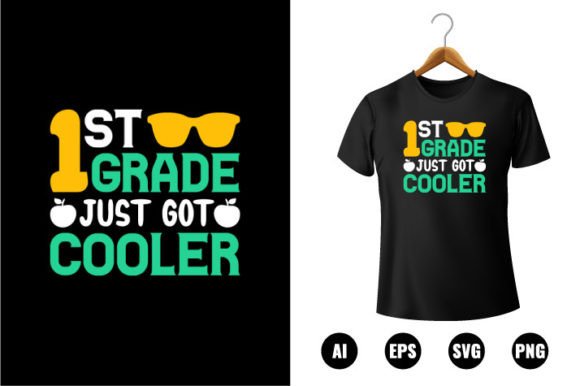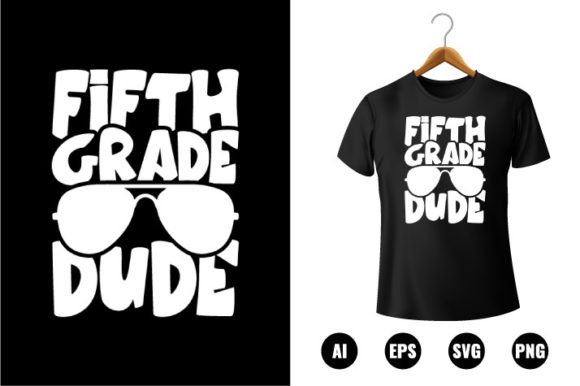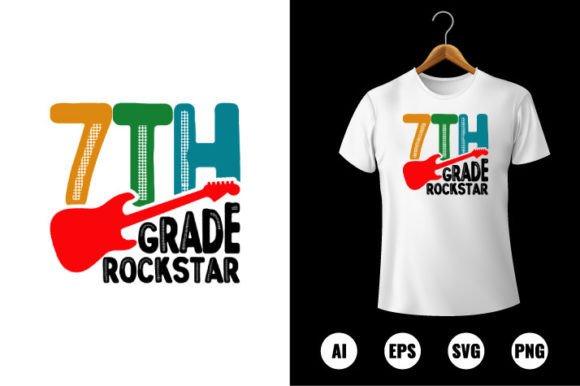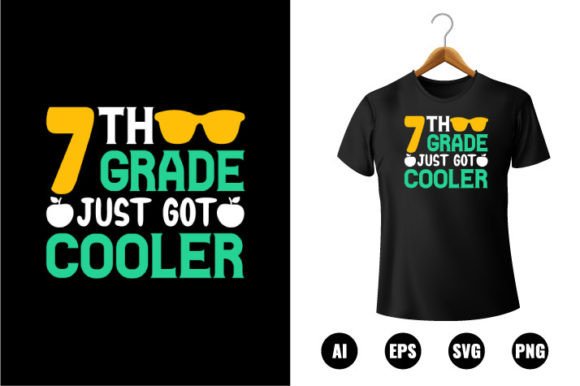
7th Grade Just Got Cooler T-shirt Design: A Versatile Digital Asset for Educators, Makers, and Small Businesses
When students walk into homeroom on the first day of school, their clothing often tells a story before they say a word. The 7th Grade Just Got Cooler T-shirt Design captures that pivotal moment—where middle school identity begins to shift from childhood curiosity to emerging individuality. But this isn’t just a playful back-to-school graphic. It’s a professionally crafted digital clip art resource engineered for flexibility, precision, and real-world usability across multiple creative and commercial workflows.
Why This Design Fits Real Educational and Creative Needs
Seventh grade marks a developmental inflection point: students start forming stronger peer identities, expressing preferences more confidently, and responding to visual language that feels authentic—not infantilized or overly academic. That’s why the 7th Grade Just Got Cooler T-shirt Design avoids clichés like cartoon apples or generic “A+” motifs. Instead, it balances wit, age-appropriate energy, and clean typography—making it resonate with kids while remaining appropriate for school-approved apparel programs, PTA fundraisers, or classroom spirit days.
Educators often overlook how much visual consistency matters in building school culture. A single well-designed shirt can unify a grade level, reduce uniform friction, and even support social-emotional goals—like fostering belonging through shared symbols. When a group of seventh graders wears matching shirts featuring this design, it subtly signals inclusion, confidence, and collective growth—not just “back to school,” but forward into a new chapter.
Digital File Formats That Enable Real-World Production
The value of the 7th Grade Just Got Cooler T-shirt Design extends far beyond its visual appeal—it lives in its technical readiness. You’ll receive four industry-standard file formats: AI (Adobe Illustrator), EPS, PNG, and SVG. Each serves a distinct purpose:
- AI and EPS files are vector-based, meaning they scale infinitely without pixelation—ideal for screen printing on oversized hoodies or engraving onto metal locker tags.
- SVG is web-optimized and responsive, making it perfect for digital classroom badges, interactive bulletin boards, or printable PDF handouts embedded in learning management systems.
- PNG delivers crisp, transparent-background raster graphics—essential for sticker sheets, vinyl decals, or layered scrapbooking projects where background removal matters.
All files are 100% print-ready, built at 300 DPI resolution—the gold standard for professional garment printing—and compatible with Adobe Illustrator CC and later versions. That compatibility ensures educators using school-issued design software, small-batch printers upgrading equipment, or hobbyists exploring Cricut Design Space won’t hit version-related roadblocks.
Practical Editing Without Technical Barriers
“Easy to edit” isn’t marketing fluff here—it’s structural reality. Every element in the design is composed of 100% vector shapes, fully ungrouped and logically layered. Colors aren’t embedded as fixed swatches; instead, they’re applied via editable color fills, allowing instant adaptation to school colors, team palettes, or accessibility needs (e.g., swapping bright yellow for high-contrast navy-and-lime). No knowledge of Bezier curves is required to change a hue or adjust spacing.
Consider a science teacher coordinating a “STEM Spirit Week.” They could take the base 7th Grade Just Got Cooler T-shirt Design, replace the default font color with metallic silver, add a subtle atom icon beside the text using the included vector library, and export a new SVG for digital display—all within 15 minutes. Similarly, a small business owner launching a local “Back to School Bash” pop-up could rebrand the same file with neighborhood landmarks and print it on tote bags, water bottles, and window decals—leveraging one source asset across six physical product types.
Beyond Apparel: Unexpected Applications Across Domains
While named as a Back To School T-shirt Design, its utility spans disciplines and industries:
- Clothing & Merchandise: Screen printing on cotton tees, sublimation on performance polos, heat-transfer vinyl for youth-sized sweatshirts.
- Engraving & Etching: Laser-cut wooden keychains for student mentors, stainless steel name tags for lab assistants, acrylic award plaques for leadership recognition.
- Printable Decor & Education Tools: Classroom door signs, behavior incentive charts, vocabulary flashcards with embedded icons, or laminated “I’m a 7th Grader” ID badges for field trips.
- Digital Integration: Animated SVG versions for school website banners, Canva-compatible templates for parent newsletter headers, or Google Slides themes reinforcing grade-level identity during orientation.
- Community Engagement: Used by libraries for summer reading kickoff events, museums for teen volunteer programs, or city recreation departments for after-school club branding.
A homeschool co-op in Oregon recently adapted the design into a canvas banner for their annual “Middle Years Showcase,” replacing “7th Grade” with “Grades 6–8” and adjusting the font weight for readability at 10 feet. Meanwhile, a Montessori school in Colorado used the SVG version to cut felt pieces for tactile spelling activities—proving that vector scalability supports both large-scale visibility and fine-motor development tools.
Design Integrity Meets Inclusive Implementation
One often-overlooked strength lies in its intentional neutrality. The design avoids gendered imagery, culturally specific references, or trend-dependent slang—ensuring longevity across school years and diverse student populations. Its “cooler” framing isn’t about popularity contests; it’s about competence, curiosity, and capability. That subtlety makes it adaptable for special education transition programs, gifted enrichment cohorts, or dual-language immersion classrooms—where visual consistency aids comprehension without oversimplifying content.
Color flexibility further supports inclusion: designers can adjust contrast ratios to meet WCAG 2.1 AA standards for visually impaired students, or switch to matte finishes for sensory-sensitive learners who avoid glossy textures. Even the typography choice—clean, sans-serif, medium-weight—prioritizes legibility over ornamentation, aligning with universal design for learning (UDL) principles.
Workflow Integration for Different User Types
How users engage with the 7th Grade Just Got Cooler T-shirt Design varies significantly by role—and the file structure anticipates those differences:
- Teachers & Administrators typically start with the PNG for quick insertion into newsletters or Google Docs, then move to SVG for editable digital signage. Their priority is speed, compliance, and alignment with district branding guidelines.
- Print Shop Operators rely on AI/EPS for precise color separation, halftone prep, and RIP (raster image processor) compatibility—especially when batching 200+ student shirts with varied sizes and ink types.
- Hobbyists & Parents gravitate toward SVG for cutting machines or PNG for home inkjet transfers. Their edits tend toward personalization—adding names, graduation years, or inside jokes—using free tools like Inkscape or Photopea.
- Small Business Owners use layered AI files to create mockups for online stores, generate variants for A/B testing (e.g., “Cooler” vs. “Brilliant” versions), and maintain brand cohesion across apparel, stickers, and packaging.
No user needs to convert formats manually or wrestle with raster artifacts. The package delivers production-grade assets out of the gate—reducing friction between idea and execution.
Long-Term Value Beyond the First School Year
Unlike disposable seasonal graphics, this design is built for reuse. Because it’s vector-based and color-agnostic, it doesn’t “age out” with fashion trends. A PTA can use it for orientation shirts in August, then repurpose the same file for “7th Grade Science Olympiad” medals in March by changing only two elements: the tagline and a supporting icon. District communications teams have archived the AI file for three consecutive years, updating only the year date and school logo placement—cutting design time by 70% annually.
That durability translates to cost efficiency. Schools operating under tight budgets avoid recurring licensing fees or per-use royalties. Educators retain full ownership of adaptations they make—no attribution requirements, no usage caps, no platform lock-in. Whether printed on organic cotton or etched onto reclaimed wood, the core design remains a stable, scalable foundation.
Final Thought: Where Clarity Meets Creativity
The 7th Grade Just Got Cooler T-shirt Design succeeds not because it shouts, but because it listens—to developmental psychology, production realities, accessibility standards, and the quiet pride students feel when wearing something that reflects who they’re becoming. It bridges the gap between “just another back-to-school graphic” and a thoughtful, reusable tool that supports learning environments, creative enterprises, and community-building efforts alike. Its strength lies in what it enables: faster iteration for busy staff, higher fidelity for professional printers, deeper customization for families, and consistent messaging for institutions—all from a single, intelligently structured set of files.