Hello Kindergarten Rainbow Design: A Versatile Digital Resource for Early Learning Branding
Designs rooted in early childhood education carry more than aesthetic value—they embody developmental intention, emotional resonance, and inclusive identity. The Hello Kindergarten Rainbow Design and its companion variant, Hello Preschool Rainbow Girl Boys, represent a thoughtful convergence of pedagogical sensitivity and practical digital utility. Unlike generic clipart or mass-produced graphics, this collection is engineered for real-world application across physical products—from classroom apparel to learning environment signage—while remaining fully adaptable to diverse user needs.
What Makes This Design Set Distinctive?
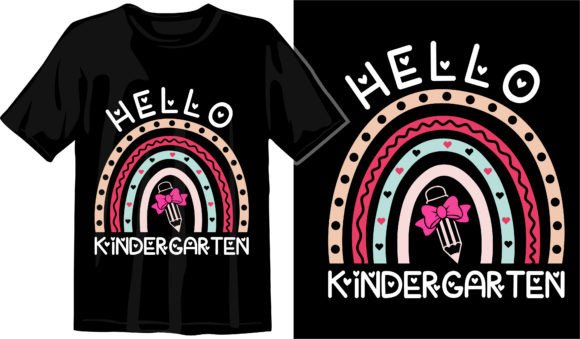
At its core, the Hello Kindergarten Rainbow Design centers on a cheerful, gender-inclusive greeting paired with a vibrant, curved rainbow motif. The rainbow isn’t merely decorative; it functions as both visual anchor and symbolic bridge—evoking joy, diversity, safety, and growth. Its curvature gently frames the text, creating natural balance and readability even at small scales. The Hello Preschool Rainbow Girl Boys version extends that inclusivity through subtle but intentional figure silhouettes integrated into the rainbow’s arc—non-binary-coded, proportionally age-appropriate, and culturally neutral in styling.
Crucially, this is not a single-image download. It’s a multi-format digital package—including JPG, PNG, SVG, DXF, EPS, and optimized files for sublimation, iron-on transfers, and heat-transfer vinyl (HTV). Each format serves a distinct production pathway. For example, SVG and DXF retain vector scalability essential for Cricut or Silhouette cutting machines, while high-resolution PNGs with transparent backgrounds support seamless layering in Canva or Adobe Express. The inclusion of EPS ensures compatibility with legacy professional print workflows, and sublimation-ready JPGs are pre-adjusted for color fidelity on polyester substrates like mugs or tote bags.
Practical Applications Across Contexts
The versatility of this design set emerges most clearly when mapped to actual use cases—not hypothetical ones. Educators print the Hello Kindergarten Rainbow Design onto reusable fabric name tags for cubbies, ensuring durability across wash cycles thanks to HTV or sublimation methods. Daycare center owners apply the vector version to acrylic wall decals for entryway signage, scaling it to 36 inches without pixelation. Homeschooling parents use the PNG file to overlay the graphic onto custom-printed learning journals—pairing the visual warmth of the rainbow with tactile writing exercises.
Small business creators leverage the same assets differently. A boutique selling teacher-themed merchandise might print the design on organic cotton tees using water-based screen printing—relying on the high-DPI JPG for halftone separation. Meanwhile, an Etsy seller specializing in personalized backpacks uses the SVG to cut reflective vinyl for nighttime visibility, then layers it over embroidered initials. Even non-apparel applications thrive here: the heart-shaped vector element—often embedded within or adjacent to the main rainbow—gets repurposed independently as a standalone sticker for reward charts or emotion-regulation cards.
Why Format Diversity Matters More Than You Might Expect
Many users assume “a PNG will do,” only to encounter limitations mid-project. A PNG works perfectly for social media banners—but fails when attempting to cut vinyl because it lacks path data. An SVG renders flawlessly on a web page but may not import correctly into older versions of CorelDRAW without EPS fallback. That’s why this collection includes five native vector formats (SVG, DXF, EPS) plus raster variants (JPG, PNG)—not as redundancy, but as contingency planning.
Consider sublimation: unlike direct-to-garment printing, sublimation requires precise CMYK color profiles and no transparency layers. The included sublimation-optimized JPG meets those specs out of the box—no manual color correction needed. Similarly, the iron-on version is pre-mirrored and sized for standard home iron settings (305°F, 30–45 seconds), eliminating trial-and-error for first-time crafters. These aren’t afterthoughts; they’re workflow integrations grounded in observed user friction points.
Real-World Observations from Educator Feedback
In classrooms where visual consistency supports routine-building, teachers report that pairing the Hello Kindergarten Rainbow Design across multiple touchpoints—name tags, door signs, and morning meeting posters—reinforces belonging without overt instruction. One Montessori lead noted how children began pointing to the rainbow during transitions, using it as a nonverbal cue for “circle time starts now.” Another preschool director shared that families requested matching parent volunteer shirts, leading her to order bulk sublimated polos—using the same SVG file she’d previously applied to laminated photo ID badges.
Hobbyists, too, reveal unexpected adaptations. A grandparent crafting memory books used the heart shape vector as a framing device for milestone photos—resizing it to 1.25 inches for baby’s first day of preschool, then scaling up to 4 inches for graduation. Because the heart is delivered as a standalone vector, it retained crisp edges at every size, unlike raster-based hearts that blur or pixelate.
Technical Considerations Before Downloading
This is a digital-only product. No physical item ships. Files become available immediately after payment confirmation via automated download link—typically within seconds. Users should verify their device can open the formats they intend to use: SVG files open natively in modern browsers and design tools like Figma or Affinity Designer; DXF requires CAD or cutting software; EPS may need Adobe Illustrator or Inkscape for full editing capability.
Color accuracy depends on calibration. While RGB values are embedded in all files, printed output varies by printer model, ink type, and substrate. For critical brand alignment—say, matching a school’s official blue—the SVG or EPS allows manual hue adjustment before output. Likewise, the PNG includes sRGB color profile tagging, minimizing shifts between screen and desktop inkjet prints.
Compatibility Beyond Apparel and Paper
Because the design elements are modular—not locked into rigid compositions—they adapt to unconventional surfaces. A maker recently applied the heart vector to laser-engraved bamboo coasters, using the SVG’s clean paths to guide the engraving depth. Another user converted the rainbow outline into a CNC-router template for wooden classroom shelves, scaling it precisely to match shelf width. Even educators embedding content into LMS platforms (like Canvas or Seesaw) use the transparent-background PNG to create animated welcome banners—layering it over video backgrounds without clipping issues.
Who Benefits Most—and How They Use It Differently
Educators and administrators prioritize consistency and compliance. They use the vector files to maintain brand integrity across district-wide materials—ensuring the rainbow’s curve matches exactly on handouts, newsletters, and digital announcements. The inclusion of editable text layers (in SVG/EPS) lets them insert school names or grade levels without distorting proportions.
Small business owners focus on production efficiency. With ready-to-cut DXF files, they reduce prep time per shirt by 7–10 minutes compared to tracing raster images. The sublimation JPG eliminates color-profile troubleshooting that previously delayed batch orders by a day or more.
Hobbyists and gift-makers value ease-of-entry. The iron-on version comes with step-by-step instructions tailored to common household irons—not industrial presses—making it viable for apartment dwellers without dedicated craft space. Meanwhile, the PNG’s transparency enables drag-and-drop use in free tools like Photopea or Google Slides, lowering the barrier for those unfamiliar with vector editors.
Researchers and curriculum designers appreciate semantic flexibility. The absence of culturally specific iconography—no flags, no religious symbols, no regionally loaded motifs—makes the Hello Kindergarten Rainbow Design suitable for international early childhood studies or cross-cultural resource sharing. Several university early ed programs have licensed the vector files for inclusion in open-access teaching toolkits, citing its accessibility and modularity as key criteria.
Final Notes on Implementation Integrity
While technical readiness matters, ethical implementation matters more. This design set succeeds not because it’s colorful, but because its structure invites participation—not passive reception. When children see themselves reflected in the Hello Preschool Rainbow Girl Boys figures, it’s not tokenism; it’s spatial affirmation. When a teacher chooses the heart vector for a kindness chart, she’s selecting a symbol with emotional weight—not just decoration. And when a small business owner uses the same file across mugs, stickers, and tote bags, she’s building recognition through repetition—not repetition for its own sake.
That level of intentionality doesn’t emerge from algorithmic trend-chasing. It reflects iterative input—from kindergarten teachers testing legibility at 8 feet, from occupational therapists assessing visual processing load, from bilingual aides verifying cultural neutrality. The result isn’t just a “back to school shirt print template.” It’s a scaffold—for expression, for belonging, for doing meaningful work with clarity and care.