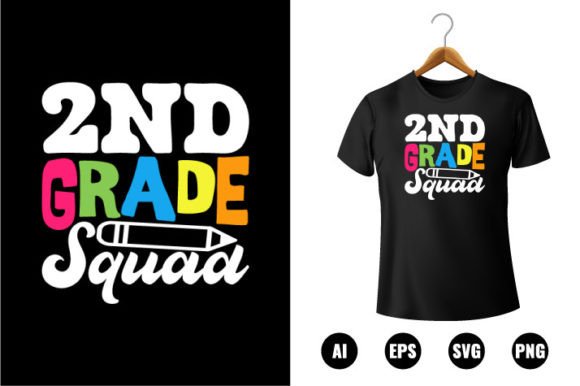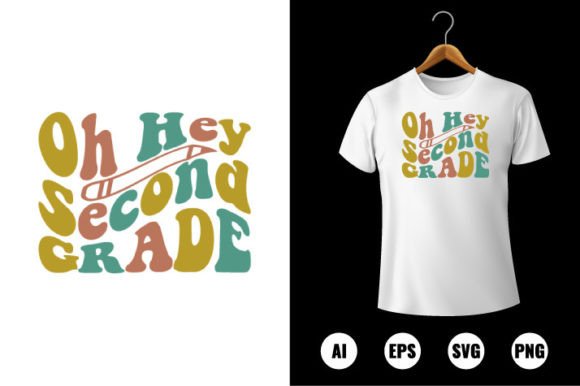
Oh Hey 2nd Grade T-Shirt Design
There’s something quietly powerful about a phrase that lands with warmth, clarity, and just the right amount of charm—like Oh Hey 2nd Grade. It’s not loud. It’s not trying too hard. But it resonates: with teachers preparing classroom welcomes, parents celebrating milestone years, PTA volunteers designing spirit wear, and small-batch apparel makers building joyful, age-specific collections. This isn’t just another back-to-school design—it’s a versatile, print-ready creative foundation built for real-world use.
More Than a Phrase—A Flexible Creative Asset
The Oh Hey 2nd Grade T-shirt Design arrives as a fully layered, professional-grade digital clip art package—not a flattened image, but a working toolkit. You’ll receive AI, EPS, PNG, and SVG files, all at 300 DPI and compatible with Adobe Illustrator CC. Every element is vector-based: infinitely scalable without pixelation, fully editable, and structured with clean layers so you can isolate text, icons, borders, or decorative accents in seconds.
What makes it especially practical? Each color is 100% changeable—no guessing, no workarounds. Swap the chalkboard blue to sunshine yellow, shift the crayon red to forest green, or convert the entire palette to monochrome for embroidery or vinyl cutting. And because every shape is a vector path—not grouped objects or embedded rasters—you can adjust stroke weights, round corners, add gradients, or combine elements with your own illustrations without breaking integrity.
Creative Uses Beyond T-Shirts
While “T-shirt design” is in the name, its utility stretches far beyond fabric. Think of it as a modular visual system:
- Classroom décor: Print on matte canvas for bulletin board headers, resize for laminated name tags, or layer with student-drawn artwork for collaborative displays.
- Digital engagement: Adapt the layout into Instagram story templates for school newsletters, or animate individual letters for a short “Welcome Back!” video intro.
- Small business merch: A local bookstore or craft café might pair the design with their logo and offer limited-run tees for “Second Grade Story Hour” events—keeping branding friendly, age-appropriate, and locally rooted.
- Parent-led projects: Use the SVG file to cut vinyl for reusable lunchbox decals, or import into Cricut Design Space to create custom iron-ons for backpacks and water bottles.
Adapting for Different Audiences—and Intentions
A teacher building classroom community might keep the design minimal—just the phrase in bold, friendly typography—printed on soft cotton tees for “Reading Buddy Day.” A homeschool co-op could recolor the icons (pencils, apples, open books) to match their group’s theme colors and print matching tote bags and folder covers. A boutique apparel brand might reinterpret the layout entirely: swap the hand-drawn font for a clean sans-serif, add subtle texture overlays, and offer it alongside “Oh Hey 3rd Grade” and “Oh Hey Kindergarten” as part of a cohesive back-to-school series.
For educators, consistency matters—not just visually, but emotionally. Using the same core design across t-shirts, welcome signs, and digital slides helps students recognize belonging and routine. For entrepreneurs, flexibility means speed: launch a new product variant in under an hour by changing one swatch and exporting a fresh PNG for your print-on-demand dashboard.
Practical Tips for Stronger Results
Start with purpose—not aesthetics. Ask: Who sees this? Where will it live? What action should it support? A sticker for a child’s notebook needs high contrast and legibility at 1.5 inches tall; a 24"x36" canvas banner can embrace detail and layered textures. Use the included vector shapes intentionally: duplicate a pencil icon, rotate it 45°, and place it behind the text for subtle depth—or delete it entirely if simplicity serves your goal better.
When editing, preserve hierarchy. The phrase “Oh Hey 2nd Grade” should remain dominant. Avoid overloading with extra graphics unless they reinforce meaning (e.g., a tiny owl for a “Wise Owls” reading program). If printing for youth, test readability: zoom out to 25% in Illustrator—if you can’t instantly parse the grade level, scale up the number or increase letter spacing.
For consistency across formats, save your final color palette as a Swatch Library (.ASE) in Illustrator. That way, whether you’re prepping for DTG printing, sublimation mugs, or PDF handouts, every output uses identical values—no mismatched blues between your website banner and the actual shirt.
Why This Works for Real Creators
This isn’t clip art you’ll use once and archive. It’s built for iteration, integration, and intention. Freelance designers appreciate the clean vectors and cross-format compatibility when delivering assets to clients who may need both web and print versions. Bloggers and educators use it to produce polished, on-brand freebies—like printable “Second Grade Goals” checklists—without hiring a designer each time. Small business owners rely on its readiness: upload the PNG to Printful, set size variants, and go live—all before lunch.
And because it’s rooted in a genuine, human tone—warm but not cutesy, simple but not sterile—it avoids aging quickly. Trends fade; sincerity doesn’t. Whether you’re launching a micro-brand, supporting a school fundraiser, or crafting a meaningful keepsake for your own child’s first week of second grade, Oh Hey 2nd Grade T-shirt Design gives you structure without constraint, polish without pretense.
Getting Started Is Simple—Staying Inspired Takes Intention
You don’t need a studio or a team to make something meaningful. Open the AI file. Try one color change. Resize the text to fit a onesie mockup. Then pause—and ask: What would make this feel like *mine*? Maybe it’s adding your school’s mascot in the corner. Maybe it’s translating “2nd Grade” into Spanish for dual-language families. Or maybe it’s leaving it exactly as-is—because sometimes the clearest message needs no embellishment.
That balance—between ready-made utility and personal voice—is where real creativity lives. Not in complexity, but in thoughtful application. With this design, you’re not buying pixels. You’re investing in permission—to adapt, refine, share, and show up, clearly and kindly, for the people and moments that matter.